
Electricity costs are becoming one of the most critical operational challenges for manufacturing businesses worldwide. As production scales up, factories consume more power, operate longer hours, and face increasingly complex electricity pricing structures. For manufacturers running shift 2 and shift 3, electricity is often consumed during peak or semi-peak periods, when tariffs are higher and demand charges can significantly inflate monthly bills.
At the same time, governments and utilities are reforming electricity markets, introducing time-of-use tariffs, demand-based pricing, and stricter grid regulations. These changes make energy costs more volatile and less predictable. As a result, traditional cost-cutting methods are no longer sufficient.
Battery Energy Storage Systems (BESS) have emerged as a practical and scalable solution. Instead of being seen as a purely technical investment, BESS is increasingly recognized as a financial optimization tool—one that allows businesses to control energy costs, stabilize cash flow, and improve long-term competitiveness.
I. Understanding Electricity Costs in Manufacturing Operations
To understand how BESS generates cost savings, it is essential to first examine how electricity costs are structured for industrial users.
Energy Charges and Demand Charges
Most industrial electricity bills consist of two primary components:
- Energy charges, calculated based on total electricity consumption (kWh).
- Demand charges, calculated based on the highest power demand (kW) recorded during a billing period.
While energy charges are relatively predictable, demand charges can be highly punitive. A short-duration spike in power usage—such as starting heavy machinery or operating multiple production lines simultaneously—can significantly increase monthly electricity costs. For many manufacturing facilities, demand charges represent a substantial portion of the total electricity bill.
Time-of-Use Pricing and Tariff Volatility
In many electricity markets, tariffs vary depending on the time of day. Electricity prices are typically higher during periods of peak demand, when grid congestion is greatest, and lower during off-peak periods.
Manufacturing facilities that operate continuously or have limited flexibility to adjust production schedules are often forced to purchase electricity at higher tariff levels. Without energy storage, businesses remain exposed to these price fluctuations, leading to higher and less predictable operating costs.
This is where BESS delivers direct economic value.

II. How BESS Reduces Electricity Costs
Peak Shaving: Lowering Demand Charges
Peak shaving is one of the most immediate and impactful applications of BESS. During periods of high power demand, the battery discharges stored energy to supplement electricity from the grid. This reduces the maximum power drawn from the grid and, in turn, lowers demand charges.
Even modest reductions in peak demand can generate meaningful monthly savings for industrial users. Over the operational lifetime of a BESS, peak shaving alone can account for a significant share of the system’s total financial benefits.
This application is particularly effective for energy-intensive operations such as heavy manufacturing, cold storage, electronics production, and automotive plants.

Load Shifting and Tariff Optimization
BESS allows manufacturers to store electricity during periods of lower electricity prices and use that stored energy when grid electricity is more expensive. This strategy—commonly known as load shifting—helps smooth electricity consumption profiles and reduces exposure to high tariffs.
Rather than adapting production schedules to electricity prices, manufacturers can use BESS to align energy supply with operational requirements. This enables uninterrupted production while improving cost predictability and financial planning.
Energy Arbitrage Opportunities
In markets with significant differences between peak and off-peak electricity prices, BESS enables energy arbitrage. The principle is straightforward:
- Charge the battery when electricity prices are low.
- Discharge the battery when electricity prices are high.
Over time, the price differential translates into measurable cost savings. For electricity-intensive manufacturing facilities, energy arbitrage can reduce average electricity costs by approximately 15–30%, depending on tariff structures, system sizing, and control strategies.
III. Avoiding Hidden and Indirect Energy Costs
Lower Dependence on Diesel Generators
Many manufacturing facilities rely on diesel generators for backup power. While effective, diesel generators involve high fuel costs, ongoing maintenance, and environmental concerns.
BESS can serve as a reliable short- to medium-duration backup power solution, reducing reliance on diesel generators. This not only lowers operating costs but also improves power quality and reliability for sensitive equipment.
Avoiding or Delaying Grid Infrastructure Upgrades
As production expands, factories may exceed their existing grid connection capacity. Upgrading transformers, substations, or grid infrastructure often requires significant capital expenditure and long lead times.
By managing peak demand and smoothing load profiles, BESS can delay or even eliminate the need for such upgrades. This allows manufacturers to scale operations without immediately increasing investment in electrical infrastructure.
Improving Power Quality and Reducing Penalties
Poor power quality—such as voltage fluctuations, frequency instability, or low power factor—can lead to utility penalties and equipment degradation.
Advanced BESS solutions, integrated with Energy Management Systems (EMS), help stabilize voltage and improve overall power quality. This reduces penalties, minimizes equipment wear, and extends asset lifespan, contributing indirectly to long-term cost savings.
IV.Financial Performance: ROI and Payback Period
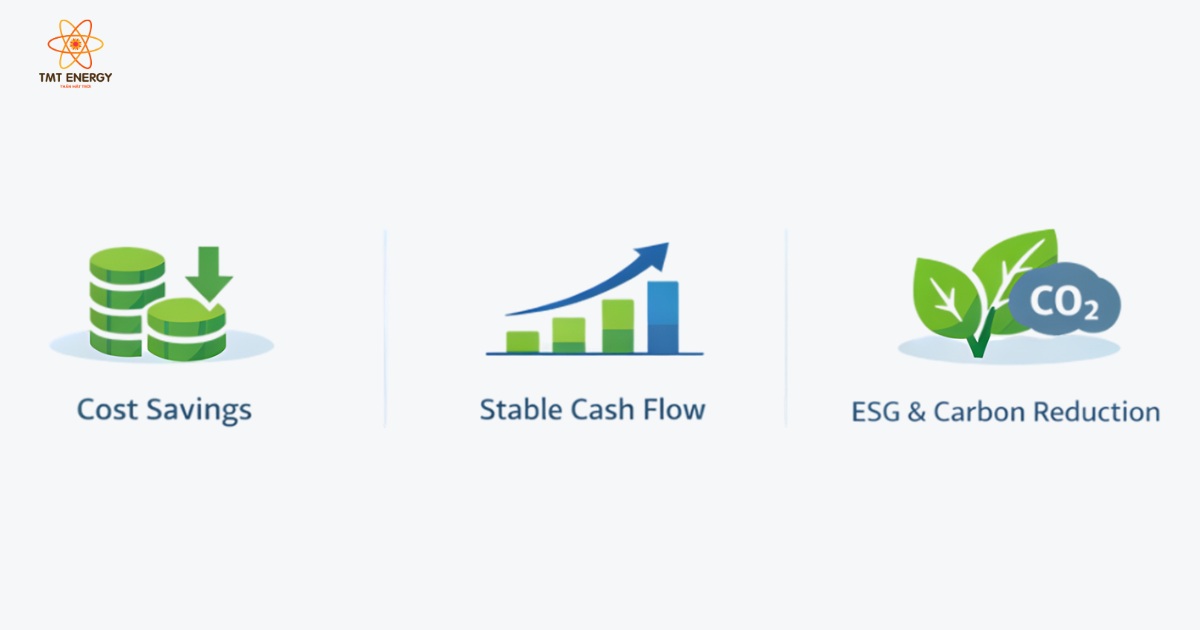
Typical Cost Savings
For commercial and industrial users, BESS can deliver:
- 15–30% reductions in electricity costs
- Greater savings in markets with demand charges and time-of-use pricing
Actual savings depend on factors such as electricity tariffs, load profiles, system sizing, and operational strategies.
Payback Periods and Investment Models
Payback periods for BESS vary depending on the investment model:
- EPC / self-investment models: typically achieve payback within 5–8 years
- ESCO or PPA models: require zero upfront capital and deliver immediate cost savings
For businesses prioritizing cash flow optimization and risk reduction, ESCO or PPA models provide access to BESS benefits without large initial investments.
V. Strategic Value Beyond Cost Savings
Supporting ESG and Sustainability Objectives
Beyond financial returns, BESS supports corporate ESG strategies by reducing reliance on fossil fuels, lowering indirect carbon emissions (Scope 2), and improving energy efficiency metrics. These benefits are increasingly important as sustainability reporting requirements become more stringent.
Preparing for Carbon Regulations and CBAM
As carbon pricing mechanisms and regulations such as the Carbon Border Adjustment Mechanism (CBAM) expand, energy efficiency and emission reduction are becoming critical competitive factors. BESS helps manufacturers reduce exposure to future carbon costs and improve compliance readiness.
Enhancing Energy Security and Operational Resilience
Power disruptions can result in costly downtime and production losses. By providing backup power and increasing grid independence, BESS enhances energy security and strengthens business resilience.
Battery Energy Storage Systems are no longer just a technical solution—they are a strategic financial asset for manufacturing businesses. By reducing demand charges, optimizing electricity consumption, avoiding infrastructure upgrades, and supporting sustainability goals, BESS delivers measurable and long-term value.
For manufacturers facing rising electricity costs, volatile tariffs, and increasing sustainability pressures, investing in BESS—whether through self-investment or zero-CAPEX models—offers a clear pathway toward cost control, operational resilience, and long-term competitiveness.
